
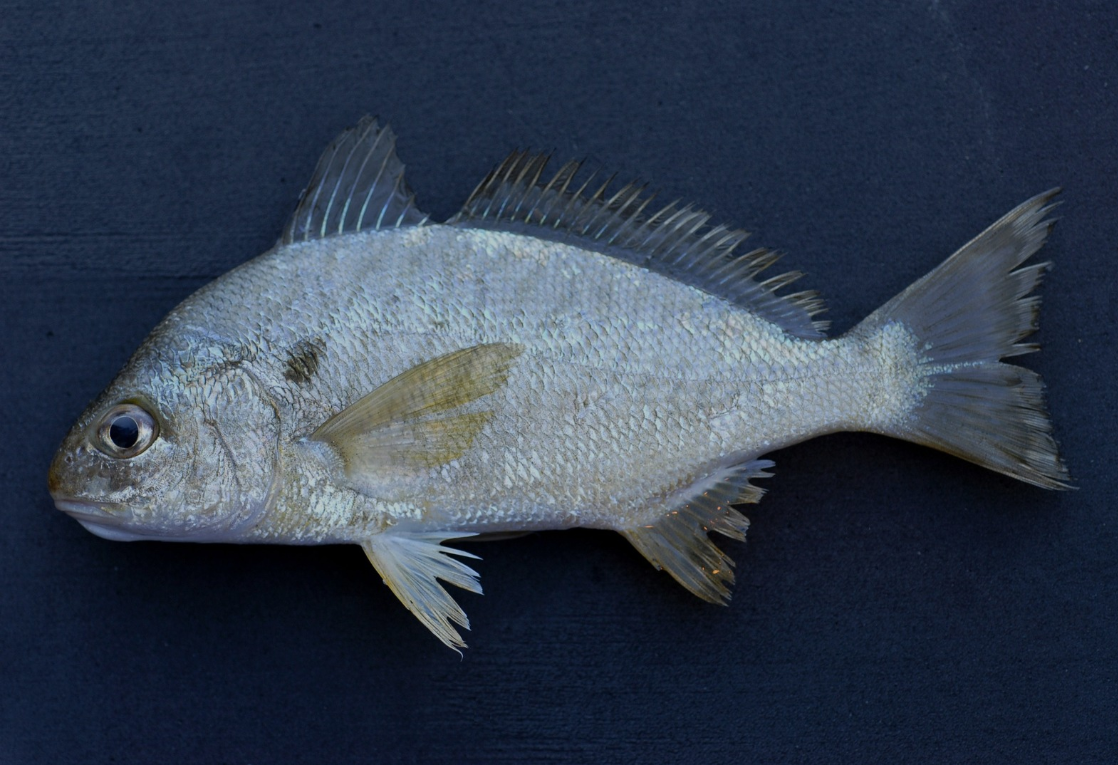
“fish4297” by NOAA Photo Library, CC BY 2.0
Do you remember the first fish you ever caught, or at least the first species? I do. Mine was a trusty bluegill (or brim, as my grandfather called them) when I was five years old. The setting was a lake in Wewahitchka, a small town in the Florida Panhandle where my grandparents had retired.
As a youngster, the only thing more difficult than spelling Wewahitchka was convincing Papa T to give me a piece of bread from the middle of the loaf instead of one of the crusty end pieces. There’s nothing quite like a little fresh bread mashed onto a hook and dropped into a school of brim circling a finger pier. I could have spent all day catching those fish. At that age, I had no idea where a fascination with fish would take me. I just knew I wanted to catch another one.
For many of you, I suspect spot played that same role. Whether fishing from a pier, a dock, or a small boat, spot have introduced countless young anglers to the excitement of feeling a tug on the line. Much like bluegill in freshwater, they’ve long been a dependable coastal favorite, especially during their seasonal fall migrations.
Despite their modest size, spot have some interesting biological connections. They belong to the drum family, making them relatives of red drum, black drum, and Atlantic croaker. Most mature within their first two years and rarely live beyond six. They spend much of their lives in estuaries, feeding along the bottom on worms, small crustaceans, and mollusks. During cooler months, adults migrate offshore to spawn, while currents carry their young into coastal estuaries.
Spot also support an important commercial fishery, with fishermen traditionally harvesting them using gill nets and haul seines. But over the past three decades, commercial and recreational harvests have changed dramatically.
In 1994, recreational anglers harvested more than 14 million spot in North Carolina, weighing approximately 4.6 million pounds. Commercial fishermen landed another 2.9 million pounds that year. Compare that with the state’s estimated spot harvest in 2025:
- Recreational harvest: 823,587 fish, weighing 325,512 pounds.
- Recreational releases: Approximately 3.64 million fish, representing 82% of the recreational catch.
- Commercial harvest: 454,473 pounds.
- Combined harvest: Approximately 780,000 pounds, compared with 7.5 million pounds in 1994.
Although recreational harvest rose from a record low in 2024, the longer-term decline is unmistakable. Commercial landings have also fallen considerably from historical levels, though they have improved somewhat since reaching a low point in 2018.
But understanding what has changed within the spot population requires looking beyond the fish brought to the dock. And that is where the story becomes more complicated.
What the Numbers Don’t Tell Us
Harvest numbers tell us how many fish are being brought ashore, but they don’t necessarily reveal the condition of the population. For spot, scientific surveys that measure abundance independently of fishing activity have not consistently shown the same declines as commercial and recreational landings. That difference has made determining the health of the population particularly challenging.
Spot are managed along the Atlantic coast through the Atlantic States Marine Fisheries Commission (ASMFC), which coordinates management among participating states. Managers currently rely on a system called the Traffic Light Approach. This method examines trends in harvest and abundance over multiple years, using green, yellow, and red indicators to identify potential concerns and determine when action is needed.
After the Traffic Light Approach signaled concerns in 2019, management measures took effect in 2021. North Carolina established a recreational limit of 50 spot per person per day and seasonal commercial closures designed to reduce harvest. Those measures remain in place. Beginning in 2027, the commercial closure will shift to January 1 through April 28 to better accommodate seasonal migrations.
One of the biggest challenges is the absence of an approved stock assessment for spot. An assessment completed in 2017 did not pass scientific peer review, leaving managers without reliable estimates of the spawning population or the rate at which spot are being removed through fishing. A new benchmark assessment is scheduled for 2027.
The 2017 peer review also examined how discards from other fisheries contribute to spot mortality. The ASMFC review panel estimated that discards from South Atlantic shrimp trawl fisheries accounted for 31% to 70% of annual spot removals during the 1989–2014 assessment period. The panel also acknowledged considerable uncertainty in those estimates due to insufficient data and identified improved monitoring of commercial discards, particularly in shrimp trawling, as a high-priority research need.
Other research priorities include gathering better information about spot growth, reproduction, and movements, along with learning how changing temperatures and ocean conditions affect their abundance. Expanded data collection and continued monitoring are essential for distinguishing natural fluctuations from meaningful changes in the population.
Spot may be small fish, but their importance to North Carolina’s coastal fishing traditions and economy is anything but small. Understanding the changes in this fishery will require better information about fishing mortality, abundance, and environmental conditions. For commercial fishermen, recreational anglers, and coastal communities alike, a clearer picture of what’s happening to spot would be a welcome development.