
What can a fish tell us about the waters it travels, the temperatures it encounters, and the places it calls home? Answering that question is at the heart of the Foundation’s red drum satellite tagging partnership. Like any ambitious research effort, this project has brought a year of adaptation and learning. We’re building on earlier deployments while refining our methods and technology to improve the quality of the data we collect.
After evaluating last year’s results, we transitioned to Wildlife Computers’ microPAT satellite tag, one of the most advanced fish-tracking technologies available. Smaller than a deck of cards and weighing just 46 grams, each tag records depth, temperature, and light levels every 30 seconds. Programmed to release from the fish five to eight months after deployment, the tag then transmits its stored data by satellite. At $4,000 apiece, these are sophisticated tools, and the information they can provide makes them a valuable investment in understanding one of our coast’s most recognizable game fish.
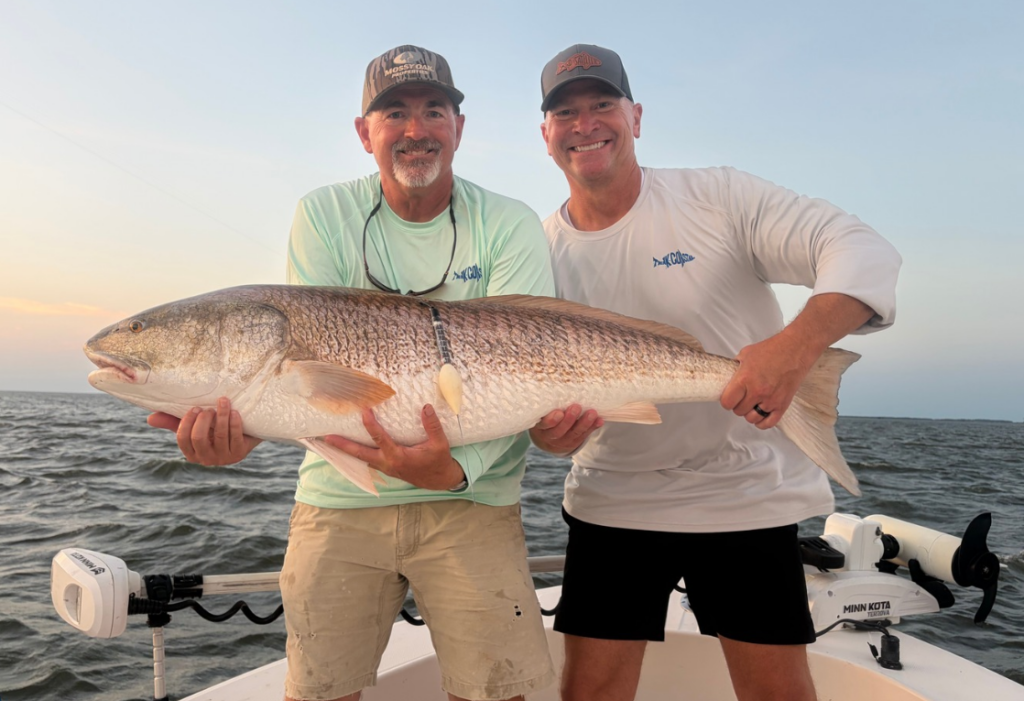
Our shipment of 10 microPAT tags arrived in early August, and we tagged our first drum on August 11. Since then, guides Bryan DeHart, Richard Andrews, and Scooter Lilley have helped us deploy eight tags during trips spanning August, September, and early October, with additional trips scheduled. Each time a tagged fish swims away, it carries a question we hope to answer, and the anticipation on the boat is shared by everyone aboard. Special thanks to the talented anglers who have helped us capture and release these magnificent fish along the way.
We’re excited to evaluate a second type of satellite tag this season. The Foundation purchased two SPOT-426 tags last month, which transmit directly to Argos satellites whenever they break the air-water interface. According to Wildlife Computers, our deployment of a SPOT-426 this past week was the first known use of this tag type on a red drum.
We’ve also refined how satellite tags are attached to the fish, moving from a side-anchor dart method to a pass-through harness designed to position the tag just above the dorsal fin. Each adjustment helps us evaluate what works best in the field, and keeping a tag on the fish is as important as the tag itself.
Last year’s research continues to provide new insights. Nearly all the tags deployed in 2025 have now released from their fish, and we’re working with John Mohan, tagging biologist with the North Carolina Division of Marine Fisheries, to interpret data streams from more than 20 drum.
Now the attention turns to what comes next. Somewhere in our waters, a red drum is carrying the first SPOT-426 deployed on its species. Each time it surfaces, it may send us a signal. Early tracks could arrive this fall, with microPAT data to follow as those tags release this winter and spring, and we’ll share what we learn on our online platform. We don’t know where the next signal will come from, but we’ll be watching the skies for it. 😊
This story was first published in our weekly newsletter. Click here to subscribe.