
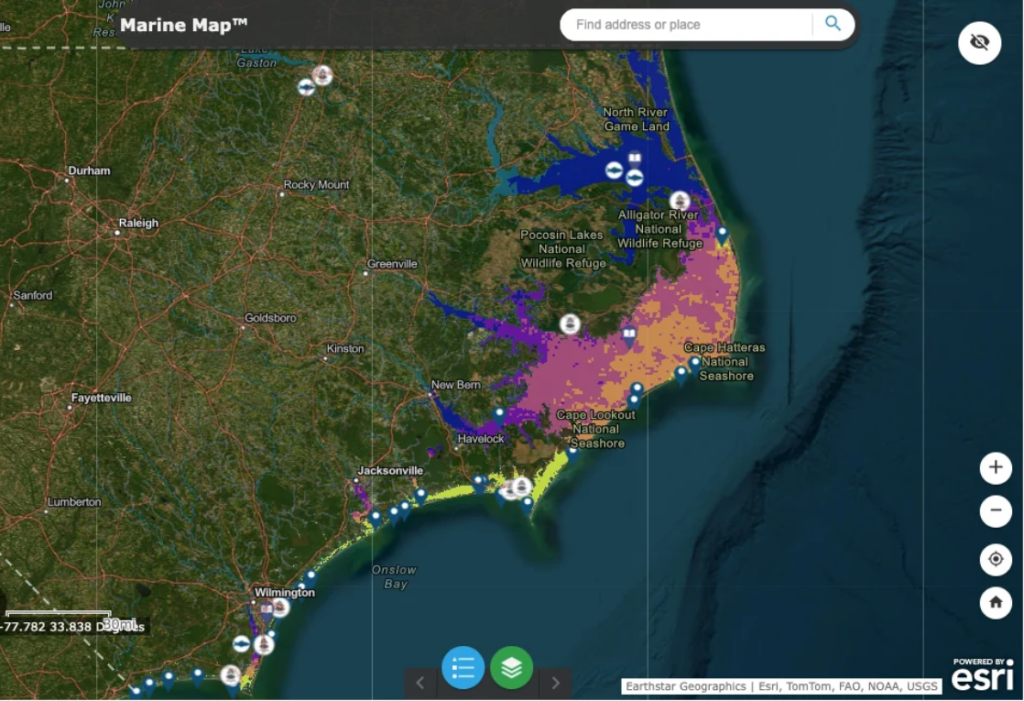
What do Albemarle Sound, Pamlico Sound, and the Atlantic Ocean have in common? They’re all part of North Carolina’s remarkable coastal water system, where salt levels can change dramatically from one location to another. Depending on rainfall, river flows, and even wind direction, the same stretch of water can become noticeably saltier or fresher over time.
Salinity describes the concentration of dissolved salts in water, commonly expressed in parts per thousand (ppt). Typical ocean water contains about 35 ppt, or roughly 35 grams of dissolved salts per kilogram of seawater. Freshwater generally contains less than 0.5 ppt, and the broad range between freshwater and ocean conditions is commonly called brackish water.
Albemarle and Pamlico sounds illustrate how geography shapes salinity. Albemarle Sound receives substantial freshwater from the Roanoke and Chowan rivers and has no direct inlet connecting it to the Atlantic Ocean. In its western reaches, salinity can approach or fall below 1 ppt, while waters farther east, toward Roanoke Island, have historically recorded levels of 2-7 ppt and sometimes higher. Pamlico Sound, however, exchanges water directly with the ocean through several Outer Banks inlets and commonly sits around 15-20 ppt.
These transitions extend into our coastal rivers. The Neuse and Tar-Pamlico rivers carry freshwater downstream into increasingly brackish estuarine waters. Farther south, the Cape Fear River and southeastern tidal creeks experience similar mixing, with salinity increasing toward their connections with the ocean.
These patterns are anything but stationary. Rainfall and river discharge push freshwater toward the coast, while tides, winds, and ocean exchange move saltwater inland. Prolonged drought can reduce freshwater inflow, allowing saltier water to extend farther upstream. North Carolina’s current drought conditions make this relationship especially timely, although the response varies among waterways. Tropical storms can produce dramatic changes as heavy rainfall and shifting winds redistribute water throughout the estuarine system.
There’s another wrinkle: saltwater is denser than freshwater. In some coastal rivers, fresher water can flow across the surface while saltier water remains near the bottom. A fish swimming near the surface may encounter freshwater conditions, while another just a few feet below experiences much higher salinities.
These constantly changing gradients help define North Carolina’s estuaries. And for the fish and shellfish that inhabit them, the amount of salt in the water can influence far more than where they choose to live.
How salty is the water in your favorite coastal river or sound? Explore the Foundation’s interactive Marine & Estuary Map to see how salt levels vary across North Carolina’s coastal waters.
Life Along the Salinity Gradient
For the fish and shellfish in North Carolina’s estuaries, salinity can influence where they feed, grow, reproduce, and survive. But here’s an important distinction: an adult animal’s tolerance for a particular salt concentration doesn’t necessarily mean its eggs or larvae can survive the same conditions.
Consider striped bass. Adults are highly adaptable, capable of living in freshwater rivers, brackish estuaries, and the Atlantic Ocean. Reproduction, however, occurs in freshwater or very low-salinity portions of coastal rivers, as their eggs and newly hatched larvae are more sensitive to salt than adults. In laboratory research involving striped bass from the Savannah River, along the Georgia-South Carolina border, egg survival declined as salinity increased, with all eggs dying within 24 hours at concentrations above 18 ppt. Young larvae were also particularly sensitive to elevated salinity, although their tolerance grew as they developed. The findings illustrate why freshwater spawning habitat matters, even for a fish capable of spending much of its adult life in the ocean.
Southern flounder follow a different strategy. These familiar flatfish spend much of their early lives in estuaries, including low-salinity waters in coastal rivers and sounds. As they mature, they migrate offshore to reproduce during fall and winter. Their young eventually return to estuarine nursery habitats, completing a life cycle that depends on connections between coastal rivers, sounds, and the ocean.
Blue crabs offer another example. Males commonly occupy lower-salinity portions of estuaries, while mature females move toward saltier water to release their larvae. Research involving North Carolina blue crabs has documented females moving from waters below 20 ppt into areas above 22 ppt for larval release. Early life stages develop in higher-salinity coastal waters before young crabs return to estuaries, where they can occupy a much broader range of conditions.
Salinity is not simply a matter of whether a species can tolerate salty or fresh water. Its importance changes throughout an animal’s life, particularly during reproduction and early development. Temperature, dissolved oxygen, habitat availability, and other factors also influence survival, making the relationship more complex than any single salinity measurement suggests.
The remarkable part is that some coastal species can move between these vastly different environments. How they manage the changing chemistry inside their bodies is another story altogether.
The Remarkable Chemistry of a Migrating Fish
Imagine spending months swimming through ocean water containing about 35 ppt of dissolved salts, then traveling inland to a coastal river where salinity approaches zero. For a migrating striped bass, that journey presents an extraordinary physiological challenge. Yet the fish can make the transition while maintaining the delicate balance of water and salts necessary for survival.
Here’s the challenge. In saltwater, the surrounding environment is saltier than the fluids inside a fish’s body, so water tends to move out of the fish while salts move in. In freshwater, the situation reverses. Water tends to move into the fish, while essential salts are continually lost to the surrounding environment.
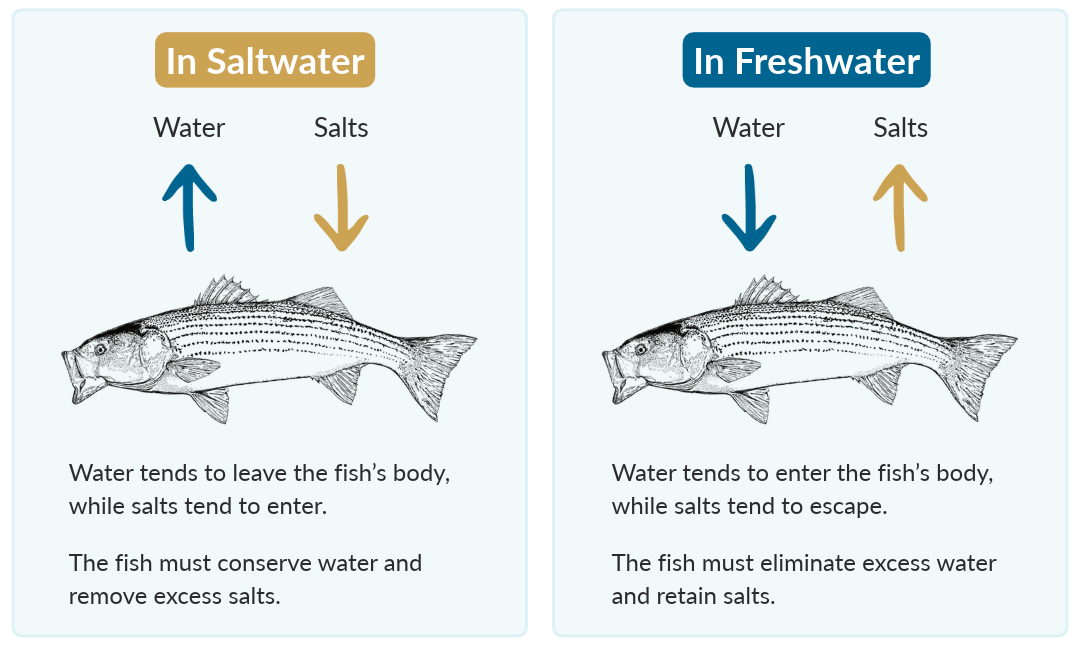
How does a striped bass survive both conditions?
The answer is osmoregulation, the ability to maintain the proper balance of water and dissolved salts inside the body. Specialized cells in the gills regulate the movement of salts, while the kidneys help control how much water and salt are retained or eliminated.
In freshwater, a striped bass can produce large amounts of dilute urine to shed excess water while actively absorbing essential salts through its gills. In saltwater, the fish adjusts by drinking seawater to replace lost fluids and using specialized gill cells to eliminate excess salts. Hormonal signals help coordinate these changes.
Not every fish has this flexibility. Many freshwater species cannot survive prolonged exposure to full-strength seawater, and many marine species cannot tolerate freshwater. Striped bass belong to a more adaptable group capable of regulating their internal chemistry across an unusually broad range of salinities.
Picture a striped bass leaving the Atlantic and swimming upstream into the Roanoke River. The water surrounding the fish can change from 35 ppt to less than 1 ppt, yet its internal chemistry remains regulated. It’s one of the less visible wonders of fish migration. Beneath the surface, a biological system continually adjusts, allowing a fish to travel between environments that would be incompatible for many other species.
This story was first published in our weekly newsletter. Click here to subscribe.